Wednesday, November 13, 2013

Can Social Media Create “Real” Social Change?


Recently I posted a YouTube video entitled “Making the Impossible Possible” wherein I expressed a strong optimism about the ability of social media technology to reach out and affect real change in the world. 

I would like to attempt to revisit that discussion using additional context from the article “Small Change: Why the Revolution will not be Tweeted” (Gladwell, 2010)

After reflecting on Malcolm Gladwell’s article, I realize that perhaps my assertions were a little bit one-sided. Having never been a part of any “real” revolution, my thoughts on social media’s role in activism are influenced by a very limited set of information sources, none of which are personal experience. 

So far, my humanitarian deeds have been limited to a few high-school abortion protests, some Christian leadership retreats and the occasional donation through Goodwill or at a Walmart checkout counter. I help the people around me and try to give time to people when they need it. Sure I’m making progress. But, in reality, not one of these utilizes social media channels to get the job done.

I “like” posts related to causes that I feel connected to. I am a Pitbull lover. I have 3 in my family and all of them are sweeter than any other breed of dog I’ve met. I don’t understand why people fear them so much and why a breed specific ban is in place against them. Whenever I see a post in support of banning the Pitbull ban, I almost always click the like button at least and sometime I share it. I know that because I clicked like there is a chance that some of the 200 something connections on my friends list will see it and maybe they will share it. I know that it might create buzz about the topic. But, when I really think about it, it usually doesn’t result in “real social change”. 

Clicking a small link on a busy Facebook page in hopes that somebody else might see it on their busy page, at best, will probably result in them doing the same. By the same token, there is always the off chance that one of those people might be looking for a pet and – seeing that post – decides to adopt a Pitbull, saving its life.

The way that the average person normally uses social media is probably not going to lead to a revolution. We have seen seeming exceptions to this rule, when somebody starts something huge using the power of a tweet. However, they are probably not what you might think of as “average people”, but are in actuality extraordinary revolutionaries and organizations. For example, the #Occupy movements which took off in late 2011 and throughout 2012 and still continue – though on a lesser scale – to the present day. (See this Wikipedia article for more on the occupy movement.)

Social media is nothing more than a new vehicle which can be used to communicate in new ways and with fewer boundaries. Like a car, truck, train or plane, some of these social media sites have more potential momentum than others, but all of them stand still without somebody piloting.

So, yes, I think social media has the potential to help assist people in bringing about real social change. However, I think that large scale social change is still fueled by the people behind the scenes as it always has been. Social media sites provide new ways to communicate. It is up to the activist individuals and organizations to harness those communication tools and to put them to use to create change.

(See: http://www.newyorker.com/reporting/2010/10/04/101004fa_fact_gladwell)
 

Thursday, October 17, 2013

Citizen Journalism: Making the World Aware


 ‘The concept of citizen journalism … is based upon public citizens "playing an active role in the process of collecting, reporting, analyzing, and disseminating news and information."’
(Wikipedia, http://en.wikipedia.org/wiki/Citizen_journalism) 

Photo by Roger H. Goun (http://www.flickr.com/photos/sskennel/)
In the age of information, nearly everybody wants to say something - and people are more enabled than ever to record, write and publish their own journalistic pieces for the world to see. When an amateur, or non-professional produces information of journalistic nature, it is sometimes referred to as citizen journalism.

A debate exists among various socialists and academics about whether or not citizen journalism is a good thing for our society and there are some strong arguments to support each viewpoint. 

For one thing, there is the question of trust in the information provided. News from citizen journalists sometimes present opinion as fact. Yet, any individual who boots up a computer can publish an article with the same potential visibility as any large news organization.

We have come to trust the more traditional media sources because they are held accountable for the legitimacy of their information by the public and by law. They check and double-check their facts, confirming their truthfulness before ever publishing an article.

Citizen journalists rarely have their facts checked before publishing, so the validity of their information is often uncertain, and we can’t hold them accountable to the same standard that we have for larger organizations. 

This would be dangerous except that, if something is “important” enough, people instantly start talking about it to each other on social media sites, blogs, forums, chat apps and more and you can be sure there will be somebody among the hundreds or thousands of people who see this information who will go to the effort of checking the facts.  If proof - for or against the facts - is found, links to any related information can then be attached to the original post or article via commenting or “sharing” and disseminated back through the same network from which the information originated.

This same phenomenon is pushing the bigger news organizations to be more responsible than ever with their information. Just as obscure indie journalists are automatically fact-checked, news organizations are also being scrutinized. They must produce rock solid facts to ensure that they are looking out for the interests of their readers. Otherwise, readers will simply go elsewhere for their news.

But, trust isn’t the only factor in the debate. There are other considerations. Citizen journalists are not required to attain any kind of certification. All they need is a computer, a subject and an internet connection to begin reporting. As a result, poor grammar, spelling and structure veritably litter many of the articles we now read. Since we often learn writing styles through reading, this can perpetuate into more unclear and/or inaccurate writing. 

That said, while the above said issue is close to the heart for this author, it must be conceded that the above concern for the quality of grammar is mostly vanity. When faced with the next element of the debate to be discussed, citizen journalism as a political device, grammar is not exactly a priority.

Events are happening in the world that certain governments wouldn’t allow traditional media access to, given the choice. China, North Korea and many other countries around the world have strict rules about what their citizens can publish or read.

The Syrian government is attacking its own people, starving them and shooting unarmed citizens down in the streets and, while the more gruesome clips are not easily available, they do exist. Renegade ‘citizen journalists’ gather footage for the world in an effort to help the Syrian people (“Al Jazeera exclusive: Homs under siege”, Al Jazeera English, YouTube.com, see http://www.youtube.com/watch?v=PMAgeCpr8t4) 

We are aware of this information because of people like these who desperately risk everything in order to gather footage, crying out for help. Their offerings attract food contributions and other assistance from outside sympathizers that might otherwise have been in the dark about what is happening to real people in war-torn countries.

‘iReport’ by CNN is an online repository for citizen journalists to submit articles that CNN can republish about subjects that are often truly important from a human perspective. Encouragement from a survivor of extreme bullying (http://ireport.cnn.com/docs/DOC-1047896) and inspiration from a once-bullied teacher (http://ireport.cnn.com/docs/DOC-1048465) are some of the things you might find when CNN requests that their user base submits stories about bullying. 

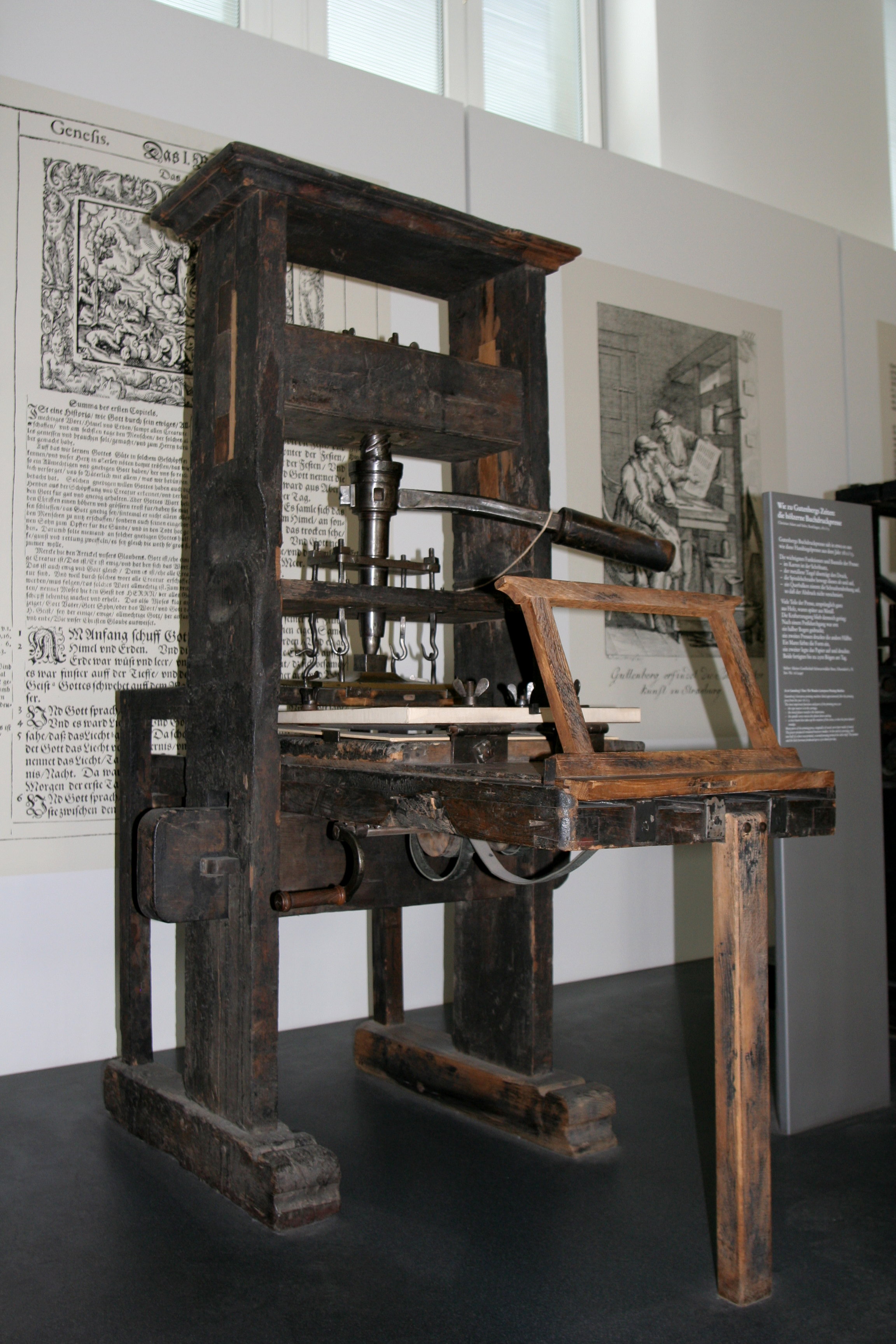
Early printing press machine, one of the first
technologies used for citizen journalism purposes
Image provided by Wikimedia
(http://upload.wikimedia.org/wikipedia/commons/1/17/
Handtiegelpresse_von_1811.jpg)
While citizen written articles are often not as high quality as we would expect from those of us with higher education, they give us far more access to information than we once would have had. As more people begin to use social media tools to publish and read their news, larger organizations are pushed to be more responsible and society can begin to hold even entire countries accountable for their actions.  

So, on the whole, this author believes that with citizen journalism the positive outcomes outweigh the relatively minor losses. Of course, this is opinion, so feel free to fact check if you feel so inclined.

Wednesday, October 9, 2013

Results, Observations and Musings about My Weekend Social Media Diet Assignment

On Friday October 4th, 2013 I began a 48 hour social media diet. I had no idea that this would be part of the curriculum going into this course, and when I found out about it, I was less than pleased. You might even say I threw a bit of a tantrum. It wasn't right as far as I was concerned. I still lean a little in that direction. 

The diet had some pretty specific expectations: no social media sites, no email, no texting, no chatting and so on. I could use my phone, but that was pretty much it. 

As a full time single parent who is taking a full time course load, working from home (using Elance, which could be interpreted as a social media website) and living out of local phone range from most of my family, social media has become a staple in my life over the past couple of years. 

It saves me a load of money to communicate through facebook chat and texting. Right now it is also a somewhat more important time in my life to communicate with my family in Toronto. We just recently found out that my father is very sick with cancer and he has started chemotherapy, so I'm in touch with my family several times each day to make sure everything is going smoothly. 

Despite the many challenges, I decided to play ball. I like good marks and new experiences and figured I would just have to foot the bill for a little more long distance if I wanted them. 

I knew I would cheat just a bit, but mostly I didn't. I got in touch with everybody ahead of time, let them know that if they texted me i couldn't answer, but that I would probably "cheat" and read hteir texts anyhow. I could call them back on teh phone if it was necessary. From Friday night until Sunday night, I didn't purposely load facebook.

I was amused at how many times I found Facebook loading, as if all by itself on my phone, iPad, laptop and home computer. I never kept it open long enough to see anything and certainly didn’t interact with it directly, and by Saturday night, I had erased my login information for Facebook from every device, deciding to add it again after my “diet”.

I had a few moments where I purposely texted because I didn’t want to spend money on long distance and I was just exasperated that I couldn’t just send my most current thoughts or questions to somebody when I wanted.

Interestingly, I had loads of work to do and had trouble concentrating on it for the first two nights because I was irritated with not being able to use the communication tools I had become so used to.

Then came Sunday afternoon. After less than two days off, I suddenly found myself more focused on the moment. I knew there were things waiting for my attention that I couldn’t deal with until Monday, but that was okay with me all of a sudden.

Sunday night, even though I could probably have gotten on Facebook, I went to sleep to enjoy a few more moments of relaxation and woke up Monday morning wishing that my diet had lasted longer.

After this experience, I look forward to the end of the school year, when I hope to do this for at least another week in 2014.

I’m copying some notes I took during the weekend from a word file below:


------


 Friday, October 4, 2013 – 8:45pm
Day Zero: 
2h15m until "blackout". I know much of my social life revolves around social media, so I'm a little unsure how to proceed. I can't just ignore a friend if they text me, and I can’t exactly turn texting off. My cell phone is my only phone, so I have to leave it on much of the time.
I have long distance family who I need to communicate with a few times a day right now (due to hospital visits and so on), so I have been relying on texting, Facebook, Carepages.com and Skype to keep that communication cheap... I will probably have to cheat a little in that respect. Will focus on the word “diet” in the Social media Diet challenge and cut down to the bare necessities.
Still not looking forward to this.
Saturday, October 05, 2013 – 9:56 AM
Woke up this morning after a good rest. Weekends are always nice because I don’t have to wake up to an alarm so I get to sleep in… but try to tell my kid that.
So I see that my phone has a text message. A good friend of mine from Toronto wants to meet up next weekend. My friend works late nights and might not get to sleep until as late as 4 in the morning. I texted back. Call it cheating if you will, but I’m not going to call first thing in the morning and wake the guy up. A text is less obtrusive and, in this case, certainly more polite.
I also have an unlimited texting bundle on my phone for $10 and long distance minutes would cost me.
That said, I had kind of forgotten my “diet”, so at the time, it didn’t occur to me that I could be cheating.
Momentarily, I back out of my text messaging screen and tap the Facebook messaging icon to see if any messages have come in while I was in bed… whoops, my internet is off on my phone, OH YEAH, I’m not supposed to be using Facebook.
Whelp, that was close.
Last night before “blackout” I turned off my phone internet to remind me, and removed my Facebook account info on my tablet to make sure I didn’t accidentally log in. Still almost had an incident when I turned on my desktop machine in the morning. Facebook happens to be my first “favorite” link on my favorites bar… Guess I’m more “addicted” to it than I thought.
Am I going through withdrawal? We’ll see.

Sunday, October 6, 2013
So I wanted to keep more notes as I’ve been going along, but yesterday was really busy! My daughter had a birthday party here, so there was a lot of bustling about for me.
 In the morning, she went out for a haircut with my sister. While she was doing that, I went to pick up a few surprise decorations for the party, and her gift from Michaels. After a quick lunch, we cleaned and reorganized our space (small apartment) to accommodate her guests. We had an hour to rest. I tried unsuccessfully to get some school work done, and then her friends started arriving.
Having something more important to do, kept me so distracted from anything internet that I didn’t even think about social media for a good part of the day yesterday.
I asked my sister to take before and after pics of my daughter’s haircut… and then I suggested she post it on Facebook. Was that cheating?
Sunday, October 6, 2013 – 7:02 PM
Okay, I admit it. I’m getting annoyed. Counting the hours until I can satisfy my curiosity about what’s happening on Facebook. Would also *really* like to communicate with my group for my group project, since I’m supposed to have something ready for them for tomorrow and I want to reassure them that it will be done, as well as specify a time, since I probably won’t finish until the night time.
I have some great pictures I took of Angela’s birthday party that I want to send to her mother. I also find that I’m distracted by the fact that I can’t “do” social networking because I’m in the mental habit of getting social for so many things in life.
I have been texting occasionally when it is unavoidable. I keep an extra balance on my cell phone for long distance, and today I actually ended up using it up to talk to people in Toronto who I would normally text instead.
Since it is so available, I have integrated Facebook and texting into my life as a means of saving money and communicating quickly. It has become a replacement for calling by phone.
 I wonder if people bother knocking on doors to see if their friends are home anymore. These days, I would probably text or send a chat message first and only go over if I knew for sure somebody was there. Hell, sometimes, I use Facebook instead of visiting somebody in person anyhow.
I’ve got to get back to some other schoolwork now. Guess I’m just venting… (and man, did it ever feel good.)
Monday, October 7, 2013 – 12:05 AM
About to load up Facebook. Was busy catching up on an episode of a show that will go unnamed (guilty pleasure) but curious to see if I actually missed anything.
… Yup. Nothing out of the ordinary. One chat message from a family member looking for info about my father and 28 various “items of interest”, only one of which was actually interesting to me (the picture I asked my sister to upload of my daughter’s before and after haircut images).
I feel a bit incomplete. Like I haven’t quite spent enough time away. There was no huge revelation. The weekend was busy. I definitely wouldn’t have spent that much time on Facebook anyhow.
…things that make you go hmmm, right?